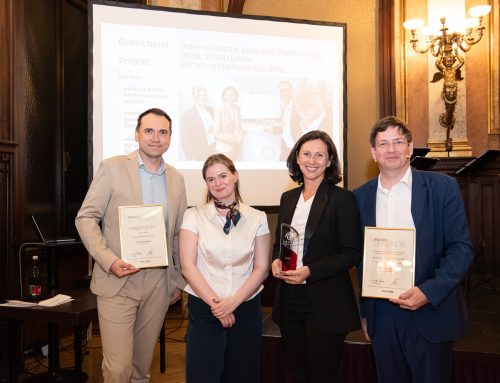
From left: Tallafuss, Oberbichler, Formanek, Kraus, Starke, Heil, Kasper, Merta, Jirgal. Photos: BRV
The circular economy is becoming increasingly important in Austria’s construction industry, with digital solutions playing a significant role in this development. At this year’s BRV Conference, it became clear that supporting the recovery and recycling of construction and demolition materials and making more targeted use of available resources requires not only appropriate regulatory frameworks but also digital tools that make information accessible in a transparent and structured way.
One of the highlights of the event was the presentation of the Recycling Platform for Construction by Katharina Heil. The platform demonstrates how digitalisation can support the planning and coordination of material flows. By digitally connecting material suppliers with potential buyers, information on available recycled construction materials, their locations and potential recovery and recycling options becomes more accessible. This makes it easier to identify regional recovery opportunities and take existing processing capacities into account during project planning. Depending on the specific project and its circumstances, this may also create opportunities to optimise transport routes.
Particularly in the area of excavated soil and materials, which account for a significant share of construction and demolition materials generated in Austria, digital matchmaking opens up new possibilities. By systematically collecting and providing relevant material information, suitable recovery and recycling options can be identified more easily, while potential applications can be considered at an early stage. Applicable quality requirements and legal regulations remain essential throughout the process.
For VITAVO, this example highlights the potential of digital technologies to support the practical implementation of circular economy principles in the construction industry. Platform solutions such as the Recycling Platform for Construction improve transparency regarding material availability and recovery opportunities, facilitate collaboration between stakeholders and provide a digital foundation for better aligning environmental objectives with economic requirements in construction project planning.